Tuesday, October 14, 2014

Camera Techniques Reflection

How I Kind Of Learned How To Use a Camera

When I started Entertainment this year, I had no idea how to use a DSLR at all, and while I am still not the most experienced in how to use one effectively and efficiently, I do at least know how to control main settings and functions of the camera. It was helpful having a list of different shots that had to be used because it allowed us to focus less on just the story and more on the relationship between the story and it's visual representation. It didn't so much matter if the story was good or not, but more on how it was displayed to the audience.

I did not shoot an individual 10-Shot Camera Technique Video, but Tara, Miranda, and I worked together on one and took turns filming shots as well as individually practicing the different techniques on our own time. I also did not edit my own version of the video, rather just contributed to the group edit.

Spoken Word Reflection

What To Do When Your Actors Cry

I was not particularly pleased with the way the Spoken Word Video turned out. While it seemed so promising in the beginning, pretty much almost everything that could go wrong, did go wrong. That may be a slight exaggeration, but I'll explain my reasoning.

It didn't take us (Miranda and I) long to find a poem we liked. That poem, She Hulk by poet Katie Pukash, perfectly represented what we believe in life and we were able to relate to the emotions behind it. It took us a few more days to plan than we wanted, but we still got it figured out and we were excited.

So Day 1 of shooting comes around and it didn't look too bright. We had a limited amount of time to film, we couldn't find as many actors as we originally planned for, and it had been raining all day. We got to our chosen location and the first half hour or so was very productive: it wasn't too wet and our lead actress was performing exceptionally. But then, tragedy struck. Not really "tragedy," our actress just had an emotional breakdown and refused to be in any more shots. And as bad as it made us feel, we filmed her crying because we needed shots of her crying and what's more believable than actual crying? While we didn't get as much done as we hoped, we still made progress (and those crying shots were really good).

Day 2 of shooting started off not as great. We couldn't get a DSLR because, well, there weren't any, so we had to shoot with a Panasonic, which I haven't had the best of experiences with in the past. The actual shoot went better than planned, but when we went to import the files onto my Macbook, they weren't there. But they showed up on Miranda's computer so we didn't think anything was wrong. 
Were we in for a surprise. 

When we got back to school, the files absolutely would not appear on the Macs, no matter what we tried. Miranda went up to Morris to ask if there was a way to fix it. 30 minutes later, she has our shots ready to be imported. The problem is, when they were finally imported, they had gone through so many processes to be usable, the quality was terrible. And, better yet, only the first half of our shots had been processed. We only had the first half of every single shot. So there went half of the motion we filmed. Still better, because we only had half the amount of footage we had planned for our pre-recorded poem, we no longer had enough footage to cover the entire poem. Insert awesome audio editing and we were able to get the audio down from 4.5 minutes to 2.5 minutes. Some "creative" video editing and we had a sub-par final video that we were not really proud of.

However, I am glad we experienced so many difficulties with this video, and early on in the year, because now we are aware of the many things that could go wrong and will be better prepared to deal with other issues in the future.

Thursday, October 9, 2014

Martin Scorsese

Plot vs. Story

Martin Scorsese, renowned director of films such as Goodfellas, The Aviator, and The Wolf of Wall Street, defines plot as what happens and story as why and how it happens. His definitions make sense because plot is more like the bones of a film, no emotions attached, the rough edges of a film. Story brings in all the elements that appeal emotionally to viewers: mood, emotion, how characters react and relate to each other, etc. Plot is the framework of a film and the basic ideas that create a film. Story is the "fluff" in between the major plot events that make the audience feel a certain way and makes the viewers feel connected to the film. Scorsese's experience in the film industry and the films he's directed make him extremely qualified to provide his ideas on film techniques, elements, and principles.

Thursday, May 1, 2014

Video Copilot: Car Hit

Back When I Thought I'd Be an Animator


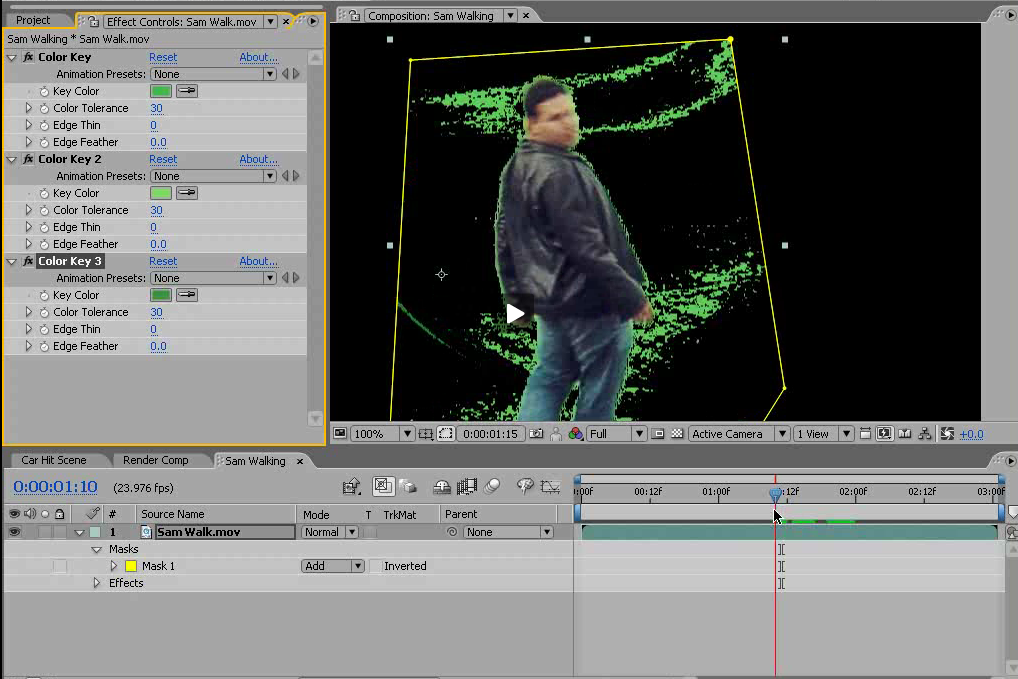
I created a mask around the main part of the guy, Sam, and used several color keys to remove the different shades of green on the green screen.


I feathered and trimmed the edges around Sam's body so he could seamlessly be placed over the truck driving clip. The background had to be slowly and carefully erased so it wouldn't look fake.

The most time consuming part of the tutorial was key framing Sam's legs. Because they weren't in front of the green screen, they each had to have a mask that was key framed at each frame to follow their movement. It was extremely tedious.


To make the truck look like Sam had actually hit it, I took a still of a smashed front end of a truck and used masks, anchor point adjustment, and motion key framing to make it crush from the impact of hitting Sam.


To create the shattering glass effect, I used the CC Particle World simulation. I adjusted the size, amount, and physics of the glass to make it look more realistic.


The best part was creating the shattering glass because most of the other steps didn't come into play, like actually fitting with the effect, until the end, whereas the glass was almost immediate. The tutorial was done really well. He did a good job of going step by step and also explaining why he was doing what he was doing and how it would contribute to the final product. And he didn't speak in monotone, so I wasn't too bored. I quite like the final result, even though it's only like two seconds long and it took me like six hours to make it. Sigh. But, all in all, I'm glad I chose this tutorial and stuck with it even when it was frustrating, which was like all the time.

Here's the link for this awesome tutorial: http://www.videocopilot.net/tutorials/advanced_car_hit/


Final Product


Sunday, March 30, 2014

The Plausible Impossible of Through the Mirror

And Other Questions on Cartoon Logic

The playing cards are chasing Mickey and throwing their face symbols at him. Firstly, cards are inanimate objects and therefore cannot move, however this cartoon is based on a fantasy novel so these actions seem legitimate. Another impossible element of this cartoon, is that the cards peel their symbols from their faces and throw them. It is impossible to peel ink from the paper it is on, but these cards were given human characteristics so this act would be much like girls throwing bras at their favorite band members.

Mickey discovers the alternate universe and walks through the mirror to reach it. It's not possible to just walk through a mirror. Trust me, I've tried. It looks like Mickey is pushing on cling wrap, or walking through a spiderweb; not solid-glass-like at all. The plausibility is in the belief and the knowledge that this is magical and a dream. Impossibility is over powered and out ruled when magic and dreams are involved because dreams are the only place where anything can happen and no one wants to get rid of that.
Mickey just ate the magical nut and his stomach starts punching him in the face and moving all around. As much as it may seem like stomachs abuse their owners at time, they don't actually jump around. The nut is magical and has power over Mickey's body, so it has the ability to control how it moves. The plausibility lies in the magic and its believability, however it is simply impossible for a single nut, or any food for that matter, to make a stomach go all cartoon jiggly jiggly.

The magical nut transformed Mickey's body into that of a giant and as he reaches his maximum height in this confined space, his head hits the ceiling and lifts it off the walls, detaching it from the house. Now, I'm unaware of the strength of giant Mickey or the sturdiness of the roof, but ceilings don't usually just lift right off like that; if they are going to break, they'll crack into pieces. Also, people don't usually grow ten feet taller after eating a single nut, but this nut is magical so I guess that explains that.
While Mickey is dancing with the queen, he flips her over so he can also dance with the second of her two heads. However, when he flips her, her single pair of legs don't move from the ground and the second head continues on with the same pair as the first. I'm not going to say it's impossible to have two heads and only one pair of legs, but the heads aren't usually on top of each other and the legs are usually CONNECTED to the body. But hey, this is a cartoon, filled with magic and nonsensical logic and details.